One Scene, Three Cuts: A Quiet Editing Exercise
This dialogue-scene editing exercise compares speaker, listener and shared-view cuts, helping you see how timing changes a conversation’s rhythm and meaning.
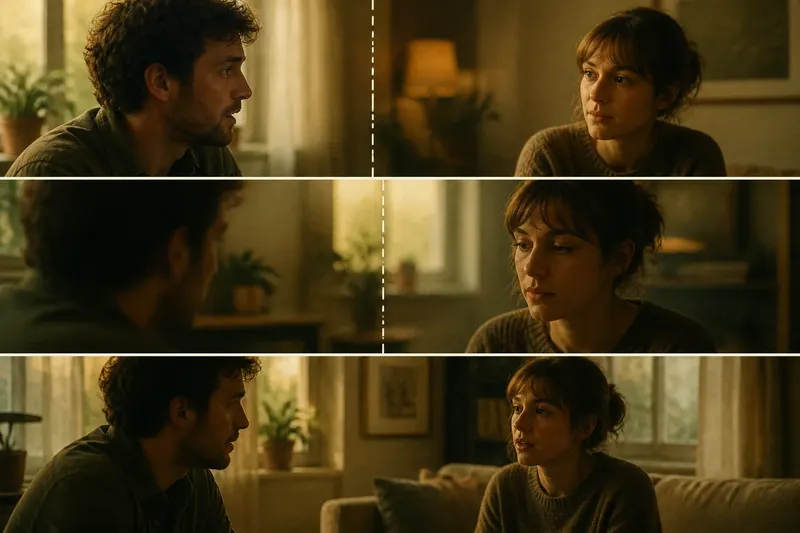
A dialogue-scene editing exercise can reveal how timing shapes a conversation, even when the camera position stays the same. Choose a short exchange and track what happens between one line and the next: who gets time to speak, when silence begins, and whether a cut interrupts or extends that silence.
This exercise compares three editing choices: cutting on a line, cutting during a pause, and delaying a cut until after a response. Treat them as different ways of shaping conversational rhythm, not as rules for where an editor should cut. A cut works a little like a comma: its placement can alter the pace and connection between thoughts without changing the words themselves.
Record the scene’s conversational rhythm
Watch the scene once without pausing. Follow the exchange as a whole, noticing interruptions, pauses, changes of subject and moments when one character does not answer straight away. You are building a baseline for how the conversation feels before examining its edits.
On a second viewing, write down each cut and the event around it. Keep the record factual: note the line, pause or response that occurs, and whether the cut comes before, during or after that event. This makes timing—not the size or composition of the shot—the centre of the exercise.
- If a cut arrives as a line begins, mark whether the new shot starts before the words or after them; then decide whether the transition feels anticipatory or simply follows the speech.
- If a cut falls during a pause, note whether the silence continues across the edit; then decide whether the pause feels sustained or broken.
- If a cut follows an interruption, record who takes the next turn; then decide whether the edit makes the exchange feel continuous or newly contested.
- If a character responds without speaking, note the timing of that response; then decide whether the edit gives it room or moves on before it develops.
- If the scene holds on one shot through several lines, note where the conversational turn changes; then decide whether the uninterrupted passage makes the exchange feel more fluid or more tense.
- If the cut coincides with a change of subject, write down the first words of the new topic; then decide whether the edit marks a clear transition or leaves the shift understated.
Do not assign a motive to every edit. First establish the order of events, as you would when marking beats in a script. Interpretation becomes more useful once you can point to the exact moment that prompted it.
Cutting on a line can make a conversational turn crisp
A cut at the start of a line can make a new speaker’s turn feel clearly separated from the previous one. A cut later in the line may let the words begin before the image changes, creating a small overlap between the old shot and the new thought.
As you watch, distinguish the sound of the line from the image change. Does the voice continue across the cut? Does the new shot arrive before the sentence is complete? These details help you describe the edit’s effect on pace without treating every cut as a visual emphasis cue.
This timing can suit a brisk exchange, but the result depends on the dialogue and surrounding pauses. A cut that seems abrupt in isolation may feel natural when the characters are trading quick replies.
Cutting during a pause can stretch the silence
A cut during a pause lets the silence continue while the image changes. The viewer experiences both the gap in speech and the transition between shots, so the pause can feel divided into distinct beats rather than left untouched.
Notice whether the next line begins immediately or whether the quiet lasts through the new shot. Also note whether a sound continues across the edit, such as room tone or a faint movement. Those elements can make the transition feel connected even when the image changes.
A pause is not empty space in a conversation. It may mark hesitation, turn-taking or a deliberate refusal to answer, but the edit alone cannot settle which interpretation is correct. Describe the duration and sequence before deciding what the silence suggests.
Delaying a cut can let a response unfold
An editor may hold a shot after a line has finished, allowing the next speaker’s answer or silence to begin before the image changes. That delay can make the conversation feel less neatly divided into turns. It may also leave a question hanging while the scene continues.
Track what happens in the interval: does someone begin to speak, change their mind, or continue a physical action? The visible event gives you a concrete reason to describe the timing. Avoid treating a delayed cut as proof of a character’s private intention.
This approach can make an exchange feel unhurried, though a long hold is not automatically calm. If the dialogue contains a demand or an unresolved question, extra time may make the moment feel more exposed.
How can you compare the timing choices?
What should I record for each edit?
Write down the words or action surrounding the cut, then mark whether it occurs before, during or after the conversational beat. Add a brief description of what continues across the transition, such as speech, silence or room tone.
Should I pause after every cut?
Pause only when you need to check the order of events. Then replay the moment at normal speed, because the interval between a line and a cut is part of the effect you are studying.
What if the timing seems unremarkable?
Record that the exchange continues without a noticeable break. Some edits are designed to remain unobtrusive, and a neutral observation is more useful than inventing a dramatic effect.
Can a scene combine all three choices?
Yes. A conversation may use crisp cuts during quick exchanges, hold through a pause, and delay another cut until a response begins. Describe the sequence in order; its pattern may matter more than any single edit.
Compare the edits against the same conversational beat
Imagine an invented scene in which one character asks, “Are you staying?” and the other waits before answering. For this example, assume the first version cuts to a new shot as the question begins, the second cuts halfway through the silence, and the third holds the original shot until the answer starts. Record those three timings in that order. The resulting comparison is specific: the first separates the question as a new turn, the second divides the silence with an image change, and the third lets the pause remain continuous until the reply. These observations describe the edit’s structure, not a fixed emotional meaning.
Use the main phrase, dialogue-scene editing exercise, as a prompt to listen for the hand-off between lines as well as the cut itself. If a transition feels abrupt, check whether speech or room tone carries across it. If a pause seems extended, mark where it starts and ends before deciding how it affects the scene.
That distinction keeps your notes useful: state what the edit does to the exchange’s timing, then describe the possible effect with care. You can compare scenes more clearly when you separate the observable cut from the interpretation it invites.